While you’re here, I hope you’ll (take a look …)
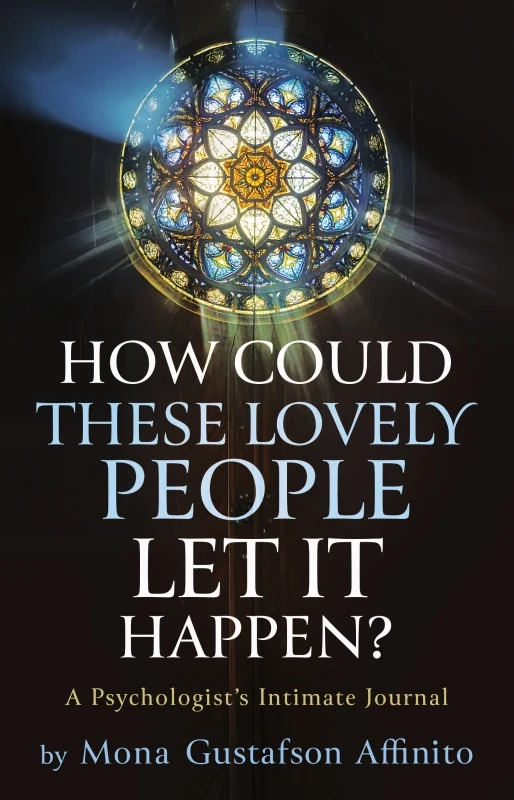
HOW COULD THESE LOVELY PEOPLE HAVE LET IT HAPPEN? A PSYCHOLOGIST’S INTIMATE JOURNAL
PREFACE
Like invisible tree roots interacting to nurture the growth of a forest, the pieces of life examined in this journal break ground in the end with an unanticipated question: What are we allowing to happen? Right here. Right now. Please experience with me my personal and professional long journey as a psychologist, from relatively simple beginnings to the gradually accumulating, eye-opening, even shocking theories and research that help in understanding the world as it is at the time of this writing.
First join me as I remember my eleven weeks in Europe, summer, 1951. We recent American college graduates, much more naïve than we thought, were on a summer tour of Europe, experiencing the debris left behind by WWII—a piece of hell we had known only from a fearful and safe distance. Now, living in the reality of it and loving the people we met in Germany and Austria, I could only wonder, “How could these lovely people have let it happen?” This theme has traveled with me throughout my long career, nurtured by the comment of our German student guide who had said, “This will come to your country someday.”
In Munich we lifted our liters of beer to the swaying gemütlichkeit of joyful community song at the Hofbräuhaus, almost forgetting how central it had been to the Nazi Party’s rise. On the streets, amidst the rubble of powerful buildings that had once defined Munich, men with missing limbs made their way hauntingly through the waste and ruin to restore a concept of home. Structures pieced together on corners from fragments marked the beginnings of local commerce. Bookstore owners frowned with confusion as I asked for something written by Sigmund Freud, long disappeared along with his banned and burned books. Fortress Hohensalzburg overlooking the city of Mozart housed still homeless people in its nooks and crannies.
Beautiful flowers filled the empty spaces—the hope of things to come. Lovely people strove to understand our minimal ability with their German language, willing to respond and converse with smiles and gestures. The orchestral performance of a Mozart Mass at the worshipful Sunday gathering in the majestic Salzburg Cathedral flooded the soul with the divine. I loved Austria and Germany, sharing their loss, admiring their fullness of life, and quite willing to tolerate the minimal supply of water: one pitcher full and a basin for two of us sharing a room. And I wondered, “How could these lovely people have allowed the horror to happen?”
The question still grasps me by day and, unfortunately, at night when I should be sleeping.
Then my thoughts—night dreams even—drift to the cultural shifts to which my own life experience has contributed, not fully recognizing at the time the disruptions that would eventually follow my personal volcanic changes. I’m referring to the feminist theme of my never-written-book A Healthy Woman is a Crazy Person. The book might have benefitted me and my career if I had found the time to write it. But I’m sure I wouldn’t have recognized then how it might ultimately contribute to the question, “Are we letting it happen?”
First let me set the stage. Do you remember when a wife was not allowed a library card in her own name? Or when department stores issued their credit cards only in the husband’s name? Do you remember when The Equal Credit Opportunity Act (ECOA) of 1974 finally made it illegal for banks to discriminate against women when lending money? Do you recall when a married woman couldn’t be a public-school teacher, or, in a somewhat more advanced later period, when a pregnant teacher had to leave her job as soon as she “showed?” I do.
Do you remember when schoolgirls were steered away from the study of math and science? And job fairs—if women were admitted at all—offered three major options: secretary, teacher, or nurse? Do you remember when a guy who wanted to study nursing was met by the parental threat to disown him? Were you around when there were no women reporters (except for the “Women’s Pages,”) or TV anchors? Or mail carriers, police officers, bank tellers, dentists, pharmacists, military officers, plumbers …? Do you remember when a bride was expected at the altar to promise to love and obey and to mean it? In fact, depending on where she lived, she literally became her husband’s property. Were you around when psychoanalysts proclaimed that a mother who didn’t “stay at home” was at fault for her child’s present or future problems? I do (and I remember feeling a bit guilty).
Do you remember when women went to college openly acknowledging the purpose of acquiring an “MRS” degree? And men were expected to be stalwart and strong under all circumstances, able to solve any problem that arose, and never to be too happy, or too sad? Do you remember when people couldn’t solve the following riddle: “A father and son were in an accident. The father was killed, and the son was taken to the hospital where the examining physician declared, in horror, ‘this is my son!’?” I do.
Ours was a society built on the assumption of the superiority of the masculine and the willing oppositeness of the feminine. The future of the newborn’s role in life was partially fixed upon delivery from the womb by the announcement of one of two alternatives: “It’s a boy,” or “It’s a girl.” It was simple and clean and dichotomous.
Should we have known that the relative success of the women’s rights movement of the 1960s and ‘70s would shake the very foundation of our culture? Women had begun to deal with their “problem that has no name,” literally encroaching on the masculine prerogative. The assumption of oppositeness lost its hold, even as we became aware of the variability of genders beyond those declared at birth.
Outside my consultation room in Connecticut, I had a collection of books to borrow. The title of one describes the way the world often seems to me these days: The Opposite of Everything is True. As men deal with their own “problem that has no name,” we all face the question of the very meaning of masculinity and femininity.
Yes, this is how I see it—where we are today: facing the decaying fruits of our deep-rooted culture of the opposites, blurring the truth of the in-betweens, almost blindly remaking who we are as people and as a people. My career as a psychologist seemed so much simpler in its beginning. Please join me as I tell my tale.